Most people know that GLP-1s work mainly by suppressing appetite, not by directly burning fat. But most people don't seem to make the distinction that because it's an appetite suppressant, a meaningful share of the weight lost can be muscle alongside fat, unless they're actively changing their lifestyle and diet to keep it. On top of that, some of the fatigue, brittle nails, poor sleep, and a myriad of other symptoms people report may come from not getting enough nutrients while eating less, rather than only from the medication itself.
Note, I'm not a medical professional, and I'm tackling this issue from the angle of micronutrient tracking and seriously training for years of my life. This post will cover the research behind GLP-1s, potential nutrient deficiencies, and recommendations for getting everything you need when your appetite is dampened.
Do GLP-1s cause nutrient deficiencies?
GLP-1s don't directly cause deficiencies. Since you're eating less, it's the same thing as a low-intake diet, and any low-intake diet can cause deficiencies. Research on this subject is somewhat thin, but it paints a good baseline. Butsch et al. is an observational study that analyzed insurance claims data from over 461,000 adults newly prescribed GLP-1s. Most of them had type 2 diabetes. 12.7% of the patients had a diagnosed deficiency within 6 months and 22.4% within 12. The most common deficiency was Vitamin D. This study was observational, so it only tracked the correlation, not causation. But it's a good starting point.
A 2026 systematic review found that only 2 of 41 randomized controlled trials (RCTs) of various forms of GLP-1s reported or assessed dietary changes. Combined with the fact that other treatments with similar effects, like bariatric surgery, have structured nutrition monitoring and a GLP-1 prescription doesn't, it tells you a lot about the current landscape of dietary care for these patients.
In essence, this means that in many cases, this falls on the patient.
You might be starting with gaps already
People who are prescribed GLP-1s might have deficiencies before even taking their first dose. Diets that are high in calories are often low in nutrient density ("empty calories"), and researchers also point to ways excess body fat itself affects how some nutrients are stored and used. They call this "overfed but undernourished". Because of this, obesity is associated with deficiencies in:
- Vitamin D
- Iron
- Folate (Vitamin B9)
- B12
- Magnesium
- Zinc
Cutting intake further can only deepen gaps that were already there if there is no change in the diet after starting GLP-1s.
The nutrients worth watching
Many of the problems I mentioned before, including fatigue, hair thinning, brittle nails, and feeling cold all the time, can come from nutrient deficiencies (though they can show up months later, and they can come from plenty of other things too). So the best option is to track your diet.
While on this appetite suppressant, certain foods also might seem less appealing, and some foods you previously ate could make you nauseous. Reduced appetite, nausea, and changed food preferences are exactly why these nutrients slip. These are good nutrients to watch and where to get them:
- Vitamin D: Most common deficiency. You can get this from fortified milk, eggs, and fatty fish. For most people, sunlight is a bigger source than food, though that depends a lot on the season and where you live.
- Iron: More relevant for women still menstruating. High in red meat, poultry, fish, beans, and fortified cereals. Vitamin C can help absorb non-heme (plant form) iron.
- B12: Almost entirely animal foods. Aversion to meat is something many people on GLP-1s report also. Alongside eggs, dairy, fish, and meat, fortified cereals have this also.
- Calcium: Mostly dairy. If you can't get it from dairy products like milk, cheese, and yogurt, non-dairy sources include sardines, canned salmon (with the bones), collard greens, and beans.
- B1 (Thiamine): Pork, beans, and seeds. Will be lowered with repeated vomiting, which is something to call your doctor about.
- Potassium and magnesium: Like B1, you can become deficient in these from GLP-1-induced vomiting (and diarrhea). Potassium is found in bananas, potatoes, and dark leafy greens. Magnesium is found in high quantities in nuts, seeds, quinoa, spinach, and dark chocolate.
Probably the most important, and easiest to fall short on, of the potential GLP-1 related deficiencies is protein. It's the first to go given its already-potent satiating effects, making it less appealing for those with reduced appetite. It's also the most important nutrient for maintaining muscle, which is why the joint advisory from four major nutrition and obesity organizations puts so much emphasis on it. And muscle is worth keeping. In a meta-analysis of about 2 million adults, higher muscular strength was linked to a 31% lower risk of all-cause mortality, and low muscle mass has been linked to higher mortality risk as well. You can get protein from nuts, legumes, dairy, Greek yogurt, poultry, and cottage cheese.
How to actually check
Most deficiencies don't produce noticeable symptoms until they've been going on for a while, and when they do, the symptoms overlap with a lot of other causes. So guessing doesn't work very well. Logging does.
- Log everything for a week: Even small bites. Especially small bites, since that's most of what you're eating.
- Read micronutrients as weekly averages: Micros swing a lot from day to day. One low Vitamin D day means nothing; seven in a row means something.
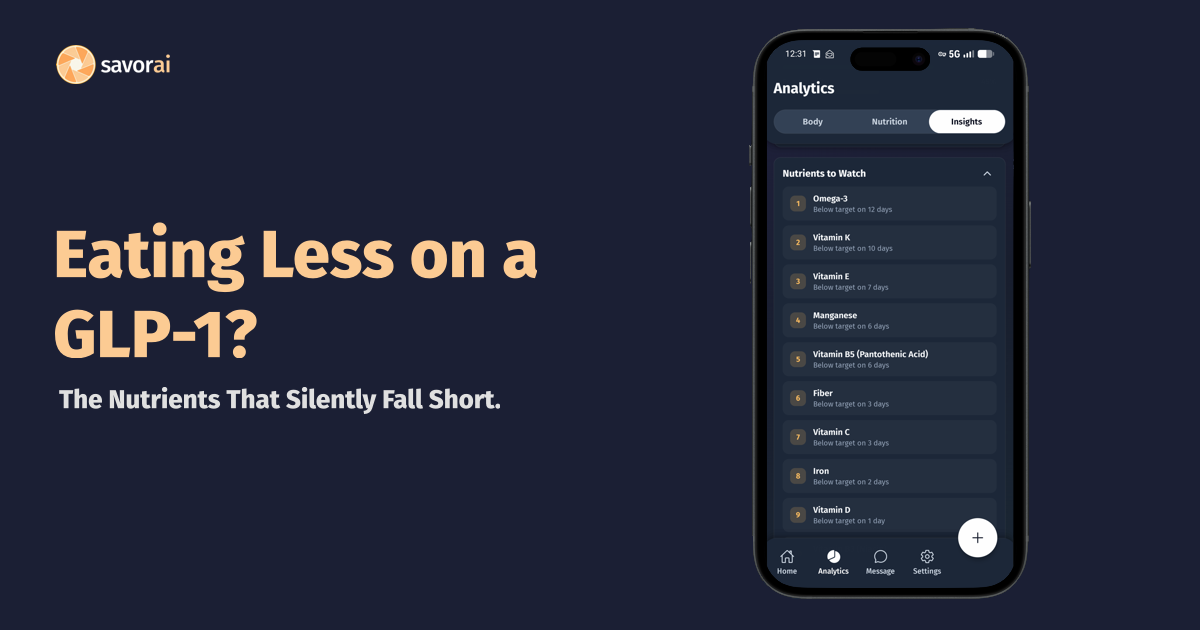
- Find the ones that are consistently low: These are the nutrients worth acting on. (SavorAI's Insights screen does this part for you, more on that below.)
- Fix them with food first: Then bring the list to your prescriber.
This is basically how I track. I care more about hitting my micros than my exact macro split (I wrote a bit about this in my post on eating out), so I check them at night. If I'm low on vitamin A, C, or E, it bugs me more than being slightly off on carbs, and it's usually an easy fix since I keep milk, oranges, and fruit juice in the house.
Note, a food log shows what you ate, not what your blood levels actually are. Absorption varies from person to person, and some people start out low. Only a blood test tells you your actual status. What a week of logging does is give your prescriber something specific to look at, rather than "I think I'm eating okay."
If you're logging in SavorAI, the "Ingredients" mode breaks each meal into individual foods, which matters here since it's the individual foods that carry the micronutrients. Then, under Analytics → Insights, the app tells you in plain language which nutrients you've been below target on for whatever date range you select. This is the most useful tool for exactly this situation, since it does the weekly-average part for you. On the nutrient screen itself, a white bar (on the default theme) means you're still under your target, and green means you've hit it.
What to eat when you can barely eat
When you can only eat a few bites, the goal is to get the most nutrients out of each one. These are good options to lean on:
- Eggs: B12, some Vitamin D, and protein. Easy to eat in small amounts.
- Milk and yogurt: Calcium, B12, and Vitamin D if fortified. Easy to drink when solid food doesn't sound good. I go through a lot of milk myself.
- Canned salmon or sardines: One of the few real food sources of Vitamin D, plus calcium if you eat the soft bones.
- Lean red meat: Iron, B12, and zinc in a pretty small portion.
- Fortified cereal: Iron, thiamine, and other B vitamins. Light and easy.
- Beans and lentils: Iron, folate, magnesium, and potassium. These are quite filling, so smaller portions.
- Oranges: Vitamin C, which also helps you absorb iron from plant foods.
On days when chewing anything sounds awful, liquid calories help. A smoothie with milk or Greek yogurt, fruit, and a spoonful of peanut butter covers a lot of ground in a few sips or spoonfuls.
And on days when your stomach just isn't having it, easy foods come first. This is what I do before a long run, when anything heavy sits wrong: applesauce, bread, or anything high in carbs and low in fat and fiber. Bananas actually make me nauseous before exercise, interestingly enough (probably the fiber). These aren't the most nutrient-dense foods, but eating something you can keep down is better than skipping the meal entirely, and you can make up the nutrients later when you feel better. Fiber is still worth getting on your better days, though, since constipation is a common GLP-1 side effect.
Should you just take a multivitamin?
Maybe. A standard multivitamin taken at the dose on the label is a pretty low-risk way to cover some gaps, and researchers are actively studying multivitamins in GLP-1 users right now.
Past that, it depends on the supplement. Doing your own research is fine, and I experiment with supplements myself. But a few of these are a different story for people on GLP-1s specifically, since many are also managing diabetes, blood pressure, or kidney issues:
- Iron: Can cause real problems if you aren't actually low. This is one to get tested for first.
- Potassium: Supplements can be dangerous with kidney problems or with some common blood pressure medications.
- Vitamins A and D at high doses: Fat-soluble, so they build up in your body over time. Stick to what's on the label.
- Anything, if you have kidney disease or take several medications: Interactions are the real risk here, not the vitamin itself.
Research can tell you what a supplement does. It can't tell you your actual blood levels. Labs can, which is why I'd still get them before supplementing anything on that list.
When to talk to your prescriber
- Before starting iron, potassium, or high-dose vitamins (or anything at all if you have kidney issues or take several medications)
- If you've been vomiting or having diarrhea regularly
- If you notice new, persistent symptoms like fatigue, hair loss, or numbness and tingling
- If your logs show the same nutrients low week after week
- Ideally, for baseline labs when you start, and periodically after
Bringing a week of food logs to that appointment is genuinely useful. It turns a vague conversation into a specific one.
TLDR
In essence, a GLP-1 handles your appetite, not your nutrition. Eating much less makes it easier to fall short on Vitamin D, iron, B12, calcium, thiamine, potassium, magnesium, and protein, and many people start with some gaps already. Log for a week, read your micronutrients as weekly averages instead of single days, eat the most nutrient-dense foods you can manage, and take what you find to your prescriber before reaching for supplements.
The medication does a lot of the work. Your nutrition is still up to you.