
Stepping on the scale, you nervously wait for a couple seconds for the reading to reveal itself. You've been tracking calories for weeks, maybe months. You've been eating right, exercising, doing everything you thought you were supposed to be doing.
But when the scale reveals itself — it hasn't even moved a pound.
The honest truth here is you were never in a calorie deficit to begin with.
Sure, there are some metabolic disorders and diseases that might make it possible to maintain your weight in a calorie deficit, but for the vast majority of the population, it's usually not hormones or age or some other kind of disorder. Those who are diagnosed with hypothyroidism or PCOS (around 5% of Americans, 8-13% of women of reproductive age) still don't defy thermodynamics. A deficit still produces fat loss, but it has to be calculated against a lower burn rate than a calculator would guess. If this is you, a dietician or other professional specializing in working with metabolic disorders can help you. That's not to say most of the advice presented below wouldn't be useful.
For everyone else: it's your tracking. Here are some reasons why you could be failing to lose weight. Much, if not all of this, can apply to weight gain as well.
The target is wrong
You might be using a calorie counter app to track your calories. Most do this, and few manually write them down anymore. Some use ChatGPT or another AI chat interface to do this. I don't think the latter is optimal for various reasons, one of which being that you're not being presented with an adequate number of calories to reach your goals. In my case, losing weight.
Apps can be the culprit too, though it often boils down to user error. Not because the users are deliberately misleading, but because they might engage in far less activity than they told the app, online calculator, or their AI. If you exercise hard on a given day, you're far more likely to lounge around and barely move the rest of the day. Your body even goes so far as fidgeting less, because it's trying to preserve calories.
This is called NEAT, aka Non-Exercise Activity Thermogenesis (thermo- "heat" genesis- "creation"; meaning heat or energy generation). Most of the active calories you burn in a day are from walking, pacing, or simply doing other daily activities you wouldn't think you're doing. You can remember this by thinking of NEAT like cleaning and making something nice and NEAT (cleaning burns calories too). If you exercise on a given day, you might cut physical corners that you wouldn't have if you weren't as tired.
Meaning you're not burning as much as you think you are. I've fallen for this too, and took my own precautions to prevent it.
You're logging less than you eat
You might be missing logs. This is the obvious one some might miss.
As an example, if you make a salad and use olive oil or another full-fat sauce as the dressing, you might grossly misjudge how much you actually used or simply ignore it since you don't think it counts for too many calories. Many beginners tend to do this, especially for olive oil. Just 1 Tablespoon of extra virgin olive oil is 120 calories. That adds up.
When I started weighing and tracking my food, I was the worst at eyeballing peanut butter, which is very dense, and overate by a lot. In fact, there were lots of extra snacks and foods I was missing entirely.
In terms of calories per gram (energy density), there are foods worth tracking as closely as you can, to make sure you're not overshooting your goal:
- Oils / Butters
- Nut butters
- Sauces
- Dressings
- Cheese
- Full-fat dairy products (e.g. whole milk, cottage cheese)
So if you're only going to weigh one thing per meal, weigh the most calorically dense food. Knowing which one that is tends to come with experience. You might just need to keep at it longer.
You haven't been at it long enough
You might be assuming you should have lost weight in the first week or two. But the scale has either gone up or it went down too little. I mean the app did say you were going to lose a pound per week, right?
Your weight is extremely variable and most fluctuations actually have nothing to do with how much you're eating. What you eat, your activity, and other variables influence how much water your body retains. Of course the physical weight of the food digesting and waste in your body matters for small fluctuations too. That's why it's best to weigh yourself at the same time every day, where those fluctuations are minimized. First thing in the morning, fasted, after using the bathroom, before drinking any fluids, is the best time to weigh yourself.
Weigh daily if you want. Just don't judge by any single reading. What you're looking for is the direction over three or four weeks, not what happened between Tuesday and Thursday.
Even then, other factors might influence these variables more long-term. For example, if you're trying to lose weight and "tone", you might be taking creatine monohydrate, which is well-known to help your muscles retain water. This has nothing to do with fat but will still cause the scale to drop slower since water weight is still weight. Body composition matters more than the number on the scale anyway.
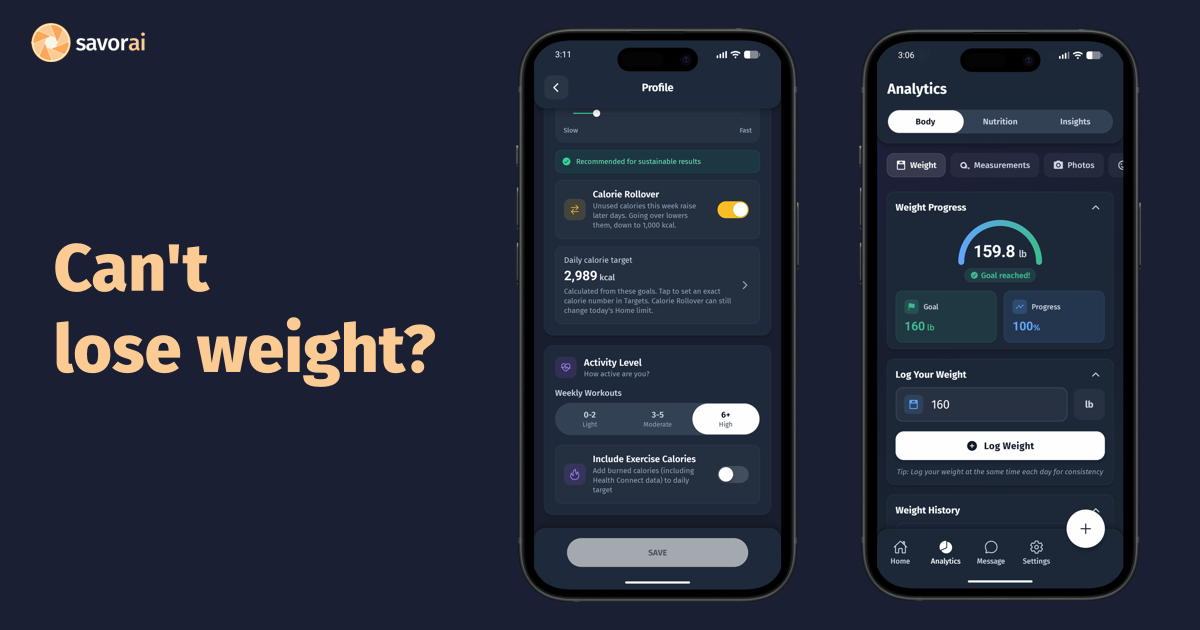
Measuring your waist, thighs, biceps, and other areas will help you determine where and how your body is physically changing. Keeping log of particular photos in similar lighting helps keep track of how your body appearance is changing. Both provide more detailed data than the scale, but your overall weight can still be quite useful alongside this data. Apps like SavorAI keep a log of your photos, body measurements, and weight, and show you the compiled data so you can see how it's trending.
What I actually do
I was a teenager at the time, using simple apps to track my food. It was during a period where I was homeschooled, so I had plenty of time on my hands. At first, I was obsessed with tracking, and weighed almost everything I ate. I was already working out. The habit was easy enough to build, until I hit two walls: eating out, and time.
I was surprised by how difficult real numbers were to find at restaurants. In the US, chains with 20 or more locations are required to publish calorie information, but finding it for what I actually ordered often didn't work, or was grossly wrong when I tried counting it. Try seeing the difference between a generic "medium fry" in a database versus the grams in an actual medium fry from any restaurant—it varies wildly.
So, I developed a dangerous perfectionism mindset. I couldn't find a Hershey Pie in a database, so I scrapped the whole day. But the database still had close enough equivalents I could estimate from. This is what ends most tracking habits.
Humans are habitual creatures, so if you tend to skip days because you don't remember everything you ate (logging before eating is ideal anyway), or you had to estimate instead of weighing, that day is as valuable as the entire habit is. Do not skip the day because of this. At worst, it's an outlier day in the data that can be ignored.
So I've learned to keep my streak up in the app even when I have to estimate the whole day. And because time constraints as a full-time employee, developer, calisthenics athlete, business owner, and writer often keep me from weighing my food, I estimate a larger percentage of what I eat than I'd like to admit.
This also means that when I go on runs burning 300, 500, or sometimes 1000+ calories, I don't log them. Same for my 20k+ steps on work days, and other exercise that burns less. Those uncounted calories effectively absorb whatever I'm overeating or underestimating elsewhere in my log. Sometimes I'll go over by a couple hundred calories on days I run half marathons, but I still try not to.
I've been doing this a while now, and I'm actually beating the pace the app set for me. It has me at -0.5 lb per week. I'm down from 168 at the end of July to 160 in September, which is an average of -1.14 lb per week.
I'm not saying everyone should do what I did. Most people probably shouldn't, if they want to control the rate of loss. If I logged more of my calories burned, I'd control it better. The point is that even estimating most of what you eat, there are methods that get you to your goal.
The checklist.
So, if you want to actually achieve your goals, there's a checklist to keep in mind:
- Has it been long enough? Weigh daily if you like, but judge the trend over three to four weeks. Any single reading is mostly water.
- Are you weighing consistently? Same time, morning, fasted, after the bathroom. Are you tracking other metrics, like measurements? Body appearance? Images, because you'll hardly notice a change looking in the mirror every day.
- If you're not weighing every food, are you weighing the densest foods? Don't weigh the lettuce. Weigh the unassuming oil.
- Be honest with your activity level. Not just your workout, but the other 16 hours you're awake. Are you walking a lot? Or sitting at a desk?
- Log everything. Even if you estimate. It is important to not break this habit. Log snacks, alcohol; even the smallest tablespoon of peanut butter you eat will have nearly 100 calories.
Conclusion
So, you can step off the scale knowing you probably don't need more cardio, it's not your hormones, and you're in control of all the variables here. Log daily. Consistency beats precision. Know where you're guessing, and utilize your app's tools to adjust your activity level as needed.
Then give the trend time to reveal itself. Don't worry, you'll get there.